

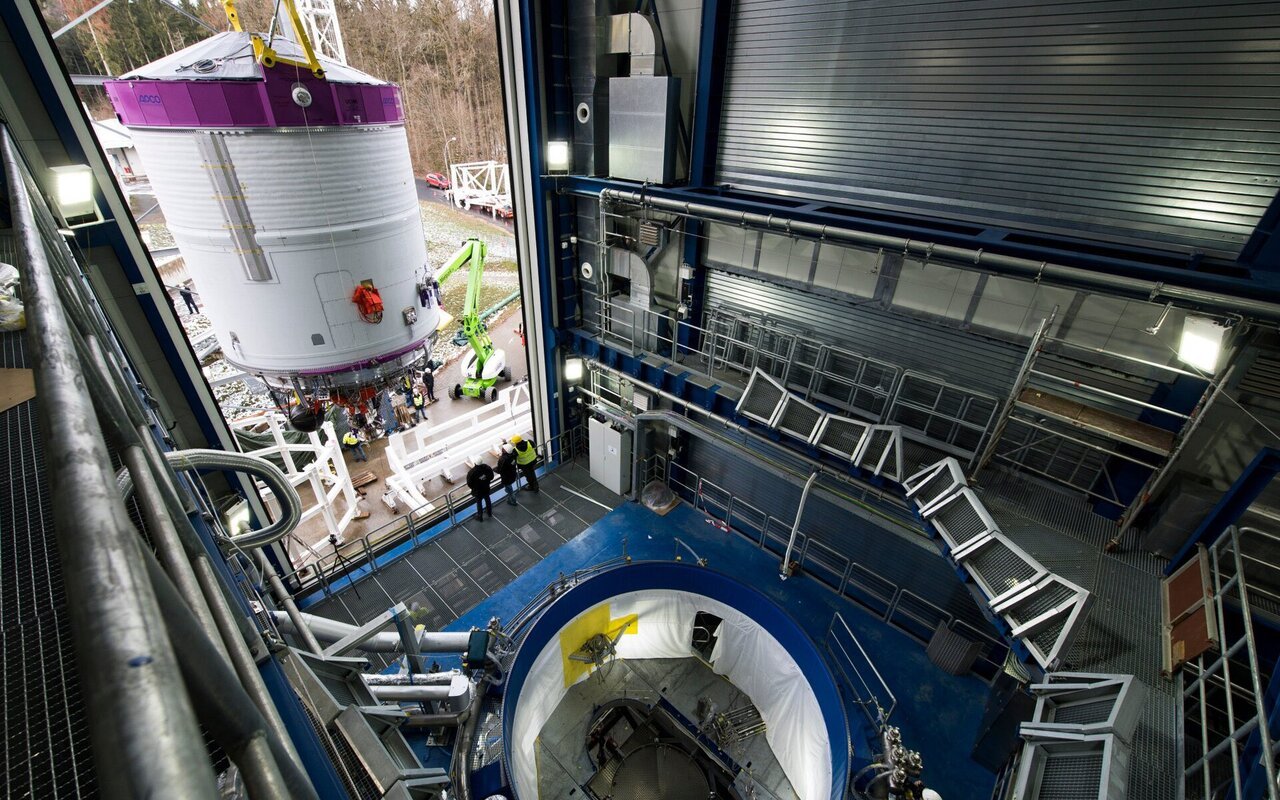
An Ariane 64 lifted off from the Guiana Space Center on Nov. 24, 2026, at 12:14 p.m. Paris time and placed 36 Amazon Leo satellites in low Earth orbit at the end of a mission lasting 2 hours and 4 minutes. It was the 10th flight of Ariane 6 and its fourth mission of the year for Amazon’s constellation. Nine days earlier, the U.S. Vulcan Centaur rocket had destroyed 40 satellites belonging to the same customer.
A liftoff in the final moments of a 29-minute window
Flight VA271 launched at 8:14 a.m. local time in Kourou, or 12:14 p.m. Paris time, according to France’s national space agency, CNES. The previous day’s attempt, on Nov. 23, had been called off because of a technical problem affecting the rocket’s ground systems, and liftoff finally took place in the final moments of a 29-minute launch window, according to Space.com. CNES, which followed the operation live, summed up the flight unambiguously: “It’s 10 out of 10 for Ariane 6!”
Thirty-six satellites deployed in two hours and four minutes
The mission lasted 2 hours and 4 minutes until all 36 satellites were deployed, again according to CNES. The version used was the Ariane 64, the one with four strap-on boosters. This launch brings to 136 the number of satellites launched for Amazon by Arianespace from French Guiana. It was Ariane 6’s fourth Amazon Leo mission in 2026, after those in February, April and June. Since its maiden flight in July 2024, the European rocket has succeeded on all its flights, with only that first launch a partial failure, according to Space.com. Arianespace has not disclosed a launch price for this mission.
Nine days earlier, Vulcan lost 40 satellites from the same customer
The contrast with the American competitor is stark. On Nov. 15, 2026, United Launch Alliance’s Vulcan Centaur suffered an anomaly a few minutes after lifting off from Florida and destroyed 40 Amazon Leo satellites. The flight was a return to flight after nine months on the ground, and it is the first total mission failure in United Launch Alliance’s history, according to Satnews and IBTimes UK. Neither Amazon nor United Launch Alliance has published a return-to-flight schedule for the rocket.
| Two flights for Amazon Leo in November 2026 | Ariane 64, flight VA271 | Vulcan Centaur |
|---|---|---|
| Date | Nov. 24, 2026 | Nov. 15, 2026 |
| Launch site | Guiana Space Center, Kourou | Florida |
| Satellites carried | 36 | 40 |
| Satellites placed in orbit | 36 | none |
| Outcome | 10th success for Ariane 6 | first total mission failure for United Launch Alliance |
Amazon at 12% of its constellation and dependent on French Guiana
Before the Vulcan failure, Amazon had deployed about 398 Leo satellites in 14 launches since 2025, or about 12% of the 3,236 satellites needed for its global service, according to Satnews. The company has purchased 38 Vulcan launches, intended to place more than 1,500 first-generation satellites. With that rocket grounded, deployment relies on Ariane 6 and on SpaceX, whose competing Starlink network already operates more than 11,000 satellites, according to Space.com. Arianespace announced on Sept. 9, 2026, a contract covering 10 Ariane 64 rockets, including six missions assigned to Amazon Leo.
What the Kourou success changes, and what it doesn’t
For the French and European space industry, flight VA271 confirms that a U.S. company is entrusting French Guiana with part of the deployment of a constellation meant to compete with Starlink. The effect remains limited for a future subscriber, however: the 36 satellites on this launch represent about 1% of the 3,236 satellites the constellation needs to cover the world, and Amazon’s schedule still hinges on Vulcan resuming flights as well as on Ariane 6’s production rate.